
Services — inversion of control with ServiceLoader
- ↑ Top
- The problem: Compile-time coupling
- The service provider interface pattern
- Step 1: Define the service interface
- Step 3: Provide the implementation
- Step 4: Update the command-line module — no more core dependency
- How
ServiceLoaderdiscovery works - The decoupled architecture
- Build and run
- Source Code
- Summary
- Homework
The previous article separated the domain types into an API module and used requires transitive to keep the wiring convenient.
The command-line module still directly instantiates TextAnalyzer from the core module — coupling the consumer to the implementation.
Java Modules provide a built-in mechanism to break this coupling: the Service Provider Interface pattern with ServiceLoader.
The problem: Compile-time coupling
After the previous article, the command-line module’s dependency graph looks like this:
cli ──requires──▶ core ──requires transitive──▶ api
The command-line module imports TextAnalyzer directly:
TextAnalyzer analyzer = new TextAnalyzer(topWords);
Statistics stats = analyzer.analyze(document);
This means the command-line module must depend on the core module at compile time. It cannot work with the API types alone — it needs to know the concrete implementation class.
This design couples consumers to implementations. Swapping, decorating, or testing with a different analyzer requires changes to the command-line code.
The service provider interface pattern
Java Modules solve this with three building blocks:
uses-
A module declares that it consumes a service interface.
provides … with-
A module declares that it provides an implementation of a service interface.
ServiceLoader-
The runtime API that discovers and loads service implementations from the module path.
The key insight: the consumer and the provider never need to know about each other. They both depend on the contract — the service interface in the API module — and the module system wires them together at runtime.
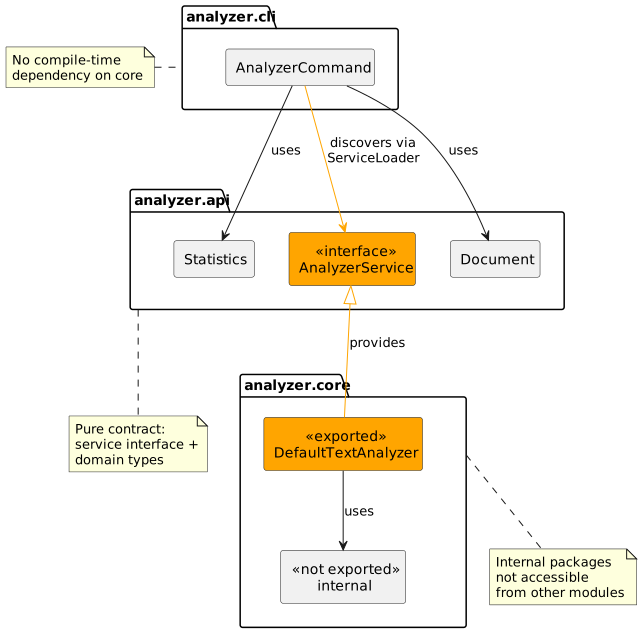
The dashed lines show runtime relationships: the command-line module discovers the AnalyzerService via ServiceLoader, and the core module provides the implementation.
Neither module references the other directly.
Step 1: Define the service interface
The new AnalyzerService interface goes into the API module.
It defines the contract that any implementation must fulfill.
/**
 * Service interface for text analysis.
 * Implementations are discovered at runtime via {@link java.util.ServiceLoader}.
 */
public interface AnalyzerService {

    /**
     * Analyzes the given document and returns statistics.
     *
     * @param document the document to analyze
     * @return the analysis statistics
     */
    Statistics analyze(Document document);
}
The interface declares a single method: analyze(Document).
It contains no discovery logic — the API module stays a pure contract with no dependencies.
The API module descriptor remains unchanged from the previous article:
module net.aschemann.maven.demos.analyzer.api {
    exports net.aschemann.maven.demos.analyzer.api; (1)
}
It exports the API package — nothing more.
Step 3: Provide the implementation
The TextAnalyzer class from the previous article becomes DefaultTextAnalyzer and implements the AnalyzerService interface:
/**
 * Default implementation of {@link AnalyzerService}.
 * Provides comprehensive text analysis with word frequency tracking.
 */
public class DefaultTextAnalyzer implements AnalyzerService { (1)

    private static final Logger LOG = LogManager.getLogger(DefaultTextAnalyzer.class);

    private static final int DEFAULT_TOP_WORDS_LIMIT = 10;

    private final int topWordsLimit;

    public DefaultTextAnalyzer() {
        this(DEFAULT_TOP_WORDS_LIMIT);
    }

    public DefaultTextAnalyzer(int topWordsLimit) {
        this.topWordsLimit = topWordsLimit;
    }

    @Override (2)
    public Statistics analyze(Document document) {
        LOG.info("Analyzing document: {}", document.path());

        String content = document.content();
        String[] lines = content.split("\\R");
        long lineCount = lines.length;

        String[] words = TextNormalizer.tokenize(content);
        long wordCount = words.length;

        long characterCount = content.length();
        long characterCountWithoutSpaces = content.chars()
                .filter(c -> !Character.isWhitespace(c))
                .count();

        Map<String, Long> wordFrequencies = Arrays.stream(words)
                .filter(word -> !word.isEmpty())
                .collect(Collectors.groupingBy(Function.identity(), Collectors.counting()));

        List<Map.Entry<String, Long>> topWords = wordFrequencies.entrySet().stream()
                .sorted(Map.Entry.comparingByValue(Comparator.reverseOrder()))
                .limit(topWordsLimit)
                .toList();

        LOG.debug("Analysis complete: {} lines, {} words, {} characters",
                lineCount, wordCount, characterCount);

        return new Statistics(
                document,
                lineCount,
                wordCount,
                characterCount,
                characterCountWithoutSpaces,
                wordFrequencies,
                topWords
        );
}| 1 | The class now implements the AnalyzerService interface |
| 2 | The analyze method fulfills the service contract |
The implementation remains otherwise unchanged — it still uses the internal TextNormalizer from the encapsulation article.
The updated core module descriptor
module net.aschemann.maven.demos.analyzer.core {
    requires transitive net.aschemann.maven.demos.analyzer.api; (1)
    requires org.apache.logging.log4j; (2)

    exports net.aschemann.maven.demos.analyzer.core.service; (3)
    // Note: net.aschemann.maven.demos.analyzer.core.internal is NOT exported

    provides net.aschemann.maven.demos.analyzer.api.AnalyzerService
        with net.aschemann.maven.demos.analyzer.core.service.DefaultTextAnalyzer; (4)
}| 1 | Transitive dependency on the API module — unchanged |
| 2 | Log4j for internal logging — unchanged |
| 3 | Export the service package — consumers can use DefaultTextAnalyzer directly if they choose |
| 4 | Declare that this module provides an implementation of AnalyzerService |
The provides … with directive serves as the counterpart to uses.
It tells the module system: "when someone asks for an AnalyzerService, a DefaultTextAnalyzer stands ready."
Step 4: Update the command-line module — no more core dependency
This step shows the payoff.
The command-line module now depends only on the API and discovers the implementation at runtime via ServiceLoader:
module net.aschemann.maven.demos.analyzer.cli {
    requires net.aschemann.maven.demos.analyzer.api; (1)
    requires info.picocli;
    requires org.apache.logging.log4j;

    uses net.aschemann.maven.demos.analyzer.api.AnalyzerService; (2)

    opens net.aschemann.maven.demos.analyzer.cli to info.picocli;
}| 1 | The command-line module requires only the API module — not the core module |
| 2 | The uses directive declares that this module discovers AnalyzerService implementations via ServiceLoader |
The uses directive must appear in the module that calls ServiceLoader.load().
Without it, the ServiceLoader finds no implementations, even if they exist on the module path.
The AnalyzerCommand now calls ServiceLoader directly instead of instantiating TextAnalyzer:
    @Override
    public Integer call() {
        try {
            String content = Files.readString(file, StandardCharsets.UTF_8); (1)
            Document document = new Document(file, content);

            AnalyzerService analyzer = ServiceLoader.load(AnalyzerService.class) (2)
                    .findFirst()
                    .orElseThrow(() -> new IllegalStateException(
                            "No AnalyzerService implementation found on the module path"));

            Statistics stats = analyzer.analyze(document); (3)

            printResults(stats);
            return 0;

        } catch (IOException e) {
            System.err.println("Error reading file: " + e.getMessage());
            return 1;
        }
}| 1 | Read the file directly — no more DocumentReader dependency needed |
| 2 | Discover the analyzer via ServiceLoader at runtime |
| 3 | Use the service interface — the command-line module has no idea which implementation it gets |
The command-line module no longer imports anything from the core module. It works entirely through the API contract.
How ServiceLoader discovery works
When the command-line module calls ServiceLoader.load(AnalyzerService.class), the following happens:
-
The runtime scans all modules on the module path
-
It finds modules that declare
provides AnalyzerService with … -
It instantiates the declared implementation class using its no-argument constructor
-
It returns the instance to the caller
The runtime defers loading implementations until iterated over or until findFirst() runs.
The decoupled architecture
Compare the module graphs before and after:
cli ──requires──▶ core ──requires transitive──▶ api
ServiceLoadercli ──requires──▶ api ◀──requires transitive── core
◀──provides──────────── core (runtime only)
The arrow between the command-line module and the core has disappeared. The core module now serves as a runtime-only dependency. It must exist on the module path when running, but the command-line module does not reference it at compile time.
This represents inversion of control: the consumer depends on an abstraction — the service interface — and the module system injects the implementation at runtime.
Build and run
Build and run the project as before:
./mvnw compile
./mvnw prepare-package
java --module-path "target/classes:target/lib" \(1)
--module net.aschemann.maven.demos.analyzer.cli/net.aschemann.maven.demos.analyzer.cli.AnalyzerCommand \
README.adoc| 1 | The core module must still exist on the module path — ServiceLoader needs it at runtime |
Even though the command-line module does not requires the core module, that module must remain present on the module path.
Otherwise, ServiceLoader finds no implementation and findFirst() returns an empty Optional.
Source Code
The above changes are commited to the sample source code repository on GitHub.
Clone it and switch to branch blog-4-services:
git clone https://github.com/aschemaven/maven-modular-sources-showcases # unless already done
cd maven-modular-sources-showcases
git checkout blog-4-services
Summary
This article covered:
-
The
usesdirective declares service consumption in a module -
The
provides … withdirective registers a service implementation -
ServiceLoaderdiscovers implementations at runtime without compile-time coupling -
The command-line module now depends only on the API module — true inversion of control
-
The implementation becomes a runtime-only dependency, injected by the module system
This pattern forms the foundation for plugin architectures in Java.
Any module can provide an AnalyzerService implementation, and the command-line module discovers it automatically — no code changes required.
Homework
- Add a second implementation
-
Create a
net.aschemann.maven.demos.analyzer.simplemodule with aSimpleTextAnalyzerthat counts only words and lines — no frequencies. Register it withprovidesand usegetAllInstances()to run both analyzers on the same document. What happens if two modules provide the same service? - Remove the core module from the module path
-
Run the app without the core module on the module path. What error message appears? How does the
OptionalfromfindFirst()help compared to aNullPointerException? - Move discovery into the interface
-
Add static factory methods
getInstance()andgetAllInstances()to theAnalyzerServiceinterface that callServiceLoader.load()internally. What changes in the module descriptors? Which module needs theusesdirective now — and why?